Local War: Global Impact
The Iran – US/ Israel War entered the 64th Day on May 02. Launched by the United States and Israel with the targeted killing of Iran’s Supreme Leader Ayatollah Khamenei on February 28, the War was expected to end within days with the capitulation of the Iranian regime post the elimination of the top leader, the timelines kept shifting forward. The War continues beyond 60 days – the period a U.S. President can continue a war without approval of the US Congress. The US Presidential office indicated that, as per regulations, there is no need for Congressional approval if a war exceeds 60 days, given that, with the declaration and acceptance of the cease-fire on April 08, the War had technically terminated.
In the interim period, Iran, having suffered multiple missiles and aerial bombardment, escalated horizontally targeting US bases in the Gulf as well as some of the countries in the region directly. According to CNN, investigations, Iran and its allies damaged at least 16 US military installations across 8 Middle East countries, leaving some facilities severely degraded and partially unusable. Iranian forces primarily targeted advanced radar installations, communications infrastructure and aircraft, seen as the most expensive losses. Pentagon – US Department of War estimates that the cost of the War to the US was US $25 billion, while some estimates bring the figure closer to $40 -50 billion, and others at least $ 100 Billion. Iran, by its own admission, has suffered losses worth $275 billion. Human lives lost are estimated to be 6700, with a majority of these from Iran and Lebanon.

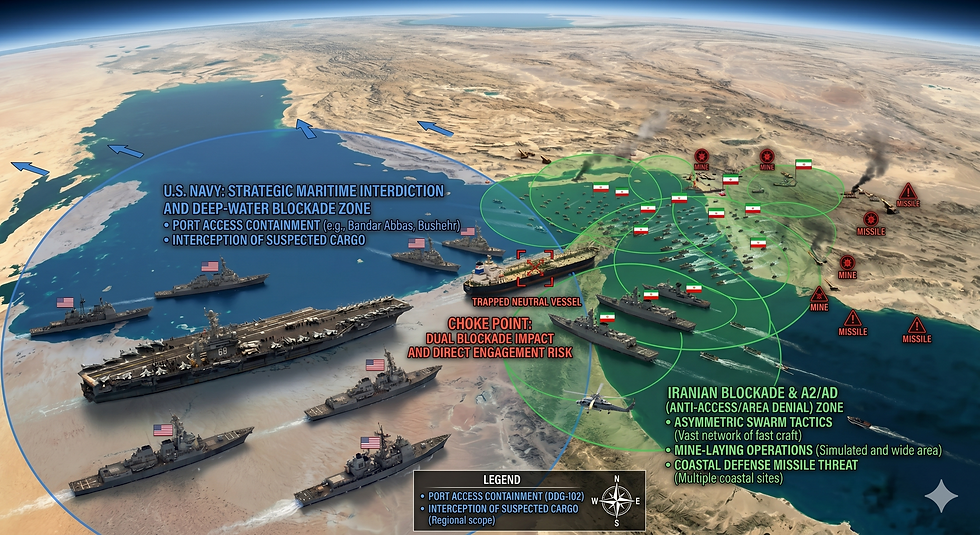
However the toll of the war expanded globally after Iran enforced control of the Straits of Hormuz, threatening to charge a toll on the lines of the Panama Canal. In response, the United States Navy imposed a blockade on Iranian ports, preventing the country from exporting oil while allowing other commerce. These moves have widened the war's impact far and wide. A Hormuz or Persian Gulf blockade is seen as the most destabilising energy shock to the global economy. It simultaneously hits oil supply, LNG flows, shipping, insurance, inflation, trade, and financial stability, with Asia bearing the brunt. Ship transits dropped 95%, from 129/day to 6/day. No viable alternative route can replace Hormuz volumes as pipelines offer only 3.5–5.5 mb/d vs ~20 mb/d normally exported.
As a United Nations Development Programme or UNDP Report, "Military escalation in the Middle East: Human Development Impacts Across Asia and the Pacific" outlines, “The implications for Asia and the Pacific extend beyond energy markets into wider trade, supply chain, and macroeconomic pressures. Disruptions to maritime transport routes and heightened geopolitical risk are expected to increase trade costs, delay shipments, and raise prices for a broad range of intermediate inputs and final goods. For economies in the region, many of which are deeply integrated into global supply chains and remain fiscally constrained, these pressures could complicate recovery trajectories and narrow the space for policy responses. Governments may be required to navigate difficult trade-offs between managing inflation, sustaining social protection, and preserving fiscal and external stability”.
Globally speaking, military escalation in the Middle East puts tens of millions of people at risk of falling into poverty across 162 countries, according to projections released by UNDP. While the impacts are concentrated in countries directly affected by the conflict and those dependent on imported energy, the findings point to significant longer-term harm to poorer countries far removed from the fighting.
Yet there are no signs of the three warring sides, the U.S., Israel or Iran relenting. The United States and Israel, while facing economic challenges, are inured to the shock of poverty by their developed status. Iran, on the other hand, is in a state of resignation, accepting interminable human and material losses while ironically “celebrating” regime survival.


Subway Surfers is an immensely popular mobile game that immerses players in a colorful world of railway tracks, where every run is a thrilling and exciting adventure.