Iran’s Five Point Strategy to Sustain Long Blockade of the Strait of Hormuz

Mohammad Sani writing in Iran’s semi-official Tasnim News Agency has highlighted how Iran proposes to sustain a long blockade of the Straits of Hormuz where diplomacy is seen as a hedge and not a resolution of the ongoing crisis as Iran also banks on international pressure for opening the Straits as the energy crisis is spiralling into a poly crisis economic challenges in Asia and Europe.
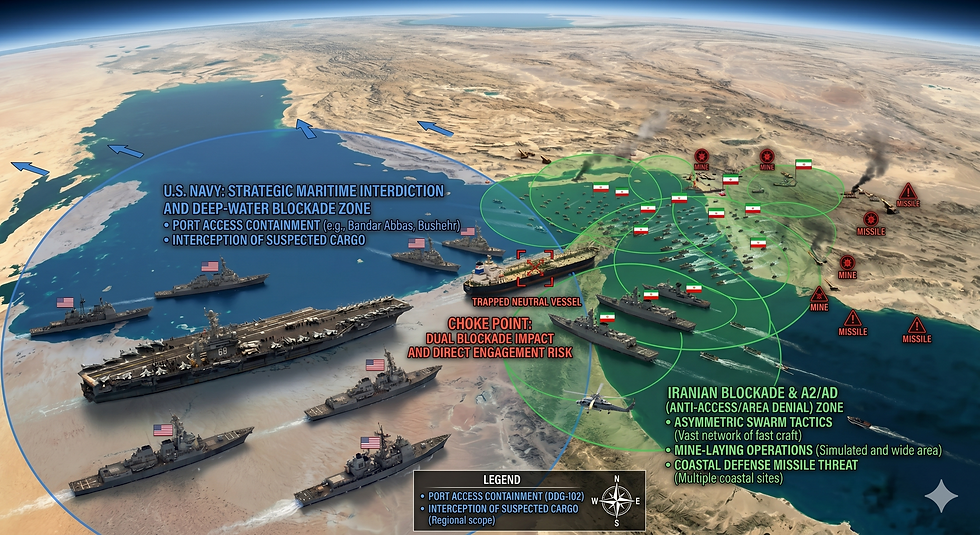
In an opinion piece in the semi-official Tasnim News Agency, “Iran’s Strategic Choices against Emerging US Maritime Siege Doctrine,” Mohammad Mohammadi Sani, dubbed as analyst of Iranian Foreign Policy and Professor of Middle East Studies highlights the possibility of the United States using maritime blockade of the Straits of Hormuz as another economic pressure point on Iran.
“Washington’s strategic bet is that growing economic strain generates domestic grievances which—if sustained long enough—may constrain Iran’s foreign policy bandwidth or even alter its internal political equilibrium. Seen through this prism, the maritime siege is not an auxiliary measure; it is the strategic center of gravity of the Trump-era Iran policy,” writes Mohammad Sani.
Thus, the blockade in the Straits of Hormuz could be prolonged.
Sani suggests five options for countering the US strategy.
(1) Bypassing Hormuz Through Eurasian Corridors. The options for these are (A) Eastern rail corridors toward China through Turkmenistan (north-eastern axis) and claims that this is economically feasible in the medium term, integrates Iran into the northern branch of the Belt and Road network and offers relative insulation from maritime disruption (B) Rail and road expansion via Pakistan (south-eastern axis) to connect Iran to Gwadar–Xinjiang corridors which provides Iran with redundancy in eastbound logistics and presents political challenges but high long-term payoff
(2) Imposing Reverse Vulnerabilities: Targeting Persian Gulf Rivals’ Alternative Routes is the second strategy proposed particularly the Abqaiq–Yanbu pipeline system on the Red Sea coast of Saudi Arabia. It moves a substantial portion of Saudi oil exports outside the maritime domain vulnerable to Iranian influence claims the author. “If Iran raises the cost or unpredictability of such infrastructure—whether kinetically, cybernetically, or through grey-zone pressure—it compels Washington and its partners to internalize a harsher cost structure for their current strategy. Iran would, in effect, be reminding adversaries that strategic asymmetry cuts both ways”.
(3) Diluting the Siege Through Third-Party Commercial Actors is the third part of the strategy by what could be said to be exploiting a “black fleet,’ “facilitating opaque shipping partnerships; offering commercial incentives for non-Western fleets; using re-flagging strategies and coordinating with states that reject US extraterritorial sanctions.
(4) Controlled Maritime Escalation: Challenging US Naval Dominance is the fourth arm of this strategy to US coercive operations in the Gulf of Oman by selective targeting and threaten escalation.
(5) Finally, is diplomacy but this as per the author is not a strategy to end the Hormuz blockade but “useful for shaping the international narrative, dividing Western allies, and demonstrating diplomatic maturity—but not reliable as a near-term exit”.
Clearly Iran is prepared for the long haul even as the people in the country are undergoing innumerable hardships with high inflation, food security and social exclusion due to blockade of the internet.


Comments