Bangladesh December Forecast: Is the BNP Losing the Plot?
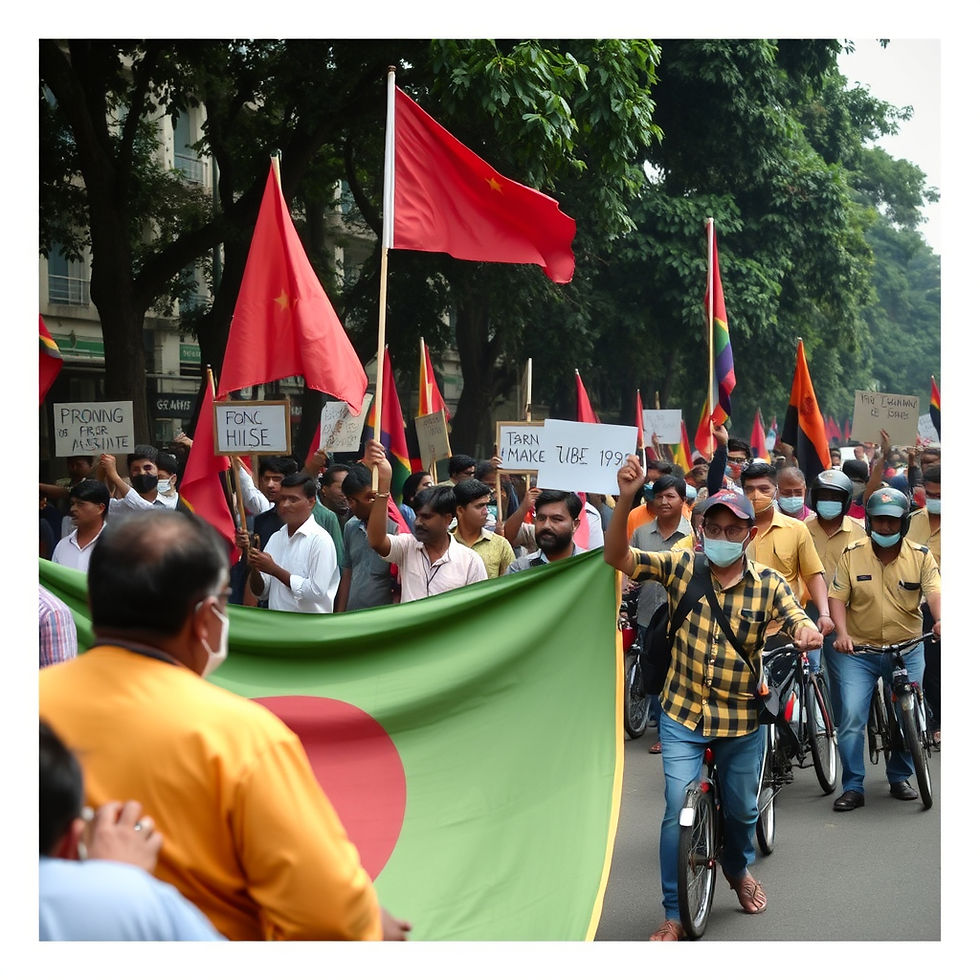
November has been turbulent in Bangladesh so far and December is likely to be more so with multiple clashes rocking Dhaka as well as the hinterland and a spike in violence ranging from attacks on houses of political leaders, riots on the streets, looting, arson and industrial unrest.
Political clashes are not new to Bangladesh which has seen cascades of violence during the turbulent periods of history since independence. Frequently this has seen a change of government the most recent being in July/August 2024.
While there is no fear of such a cataclysm occurring now, yet the spiral of violence raises concerns of destabilisation given mismanagement of the political, internal security and in fact even foreign policy.
This belies the hope that was generated when Mr Tarique Rahman returned to the country and the Bangladesh Nationalist Party [BNP] swept the polls in February this year.
The people voted for the BNP preferring the moderate party over its opponents the Jamaat and the National Citizen’s Party. Translating this confidence of the masses into stability has proved to be a challenge for the Prime Minister Tarique Rehman and his team.
Mr Rahman who is not new to the violent politics of the country having seen it upfront since his childhood should not have been surprised by the trajectory taken in the past eight months of his being at the helm of the country.
The period should have been employed for consolidation of legitimacy of power and undermining the main opponent the Awami League. Banning the Party was not enough for the large support base could not be relegated merely by imposing a ban. Coopting was perhaps a better option but with politics in Bangladesh operating on the binary of the BNP or the Awami League this does not appear to be on the agenda of any government in Dhaka.
That exiled Prime Minister Sheikh Hasina would remain a factor in the country’s politics should also not be surprising given her ability to spring back to the limelight having faced many setbacks in the past. A trial by the International Criminal Court and sentencing to death was not enough to rein in the vitriolic leader on exile in India. The BNP’s only focus was asking India to extradite Hasina. Given that she has been sentenced to death it would not be easy for New Delhi to do so apart from she being seen as an ally of the country for many decades. Moreover, extradition clause also has a political caveat.
The aim should have been to marginalise Hasina preventing her from playing politics from her safe house in Delhi. For this engagement with India was essential. While India reached out to Bangladesh, the visit of Prime Minister Rahman became a sticky point. Tarique visited countries from Malaysia, to China, Turkey and the UN General Assembly but did not find time to visit Delhi despite two invitations – one bilateral and one for the BIMSTEC summit.
While there were political voices in Bangladesh including many from his own Party against the same due to presence of Hasina in India, this was not difficult to surmount. A visit would have ensured India was on his side placing the onus on Delhi for preventing destabilising activities from its soil. Now the moment has passed.
The outcome is Hasina’s multiple statements, calls for return of passport and threat to reach Bangladesh in December.
As violence has surged across the country many are linking this to the Awami League and Chhatra Dal activists. Gopalganj witnessed some of the worst clashes. Violence was also reported in Dhaka, Chattogram, Natore, Khulna, Faridpur, Barguna, Manikganj, Naogaon, Kishoreganj, Shariatpur, Madaripur, Rajshahi and Kurigram, among other districts as per reports from Bangladesh media.
Meanwhile the Readymade Garment Sector [RMG] is in turmoil due to demand for a hike in wages. 147 factories employing around 3 lakh workers are unable to operate because of the unrest. Of them, 55 factories had already invoked Section 13(1), while production at another 92 units was severely disrupted before they were forced to shut down.
The Prime Minister’s approach currently is a call for opposition unity to meet the challenge unitedly and naming the Awami League fascist and a terrorist force. As Leader of the House Tarique Rahman and Opposition Leader Shafiqur Rahman held a one-on-one meeting at the Prime Minister’s Office in the Jatiya Sangsad Bhaban and agreed to set aside political differences and work together to address the ongoing unrest, “When we are making attempts to transform this country into a self-reliant Bangladesh … it is precisely at this time that the fallen, fugitive and ousted fascist forces have started conspiring against Bangladesh,” Rahman told lawmakers in parliament on November 18.
At the BNP parliamentary party meeting at the Jatiya Sangsad Bhaban, Tarique directed MPs to return to their constituencies immediately, strengthen grassroots activities and maintain a visible presence on the streets amid political tensions.
Meanwhile, the blame game with India has already commenced with the culpability for current spike placed on Delhi. National Citizen Party (NCP) Senior Joint Convener and lawmaker Hasnat Abdullah alleged that India is using Awami League and Chhatra League to wage a “proxy war” against Bangladesh. “This is India’s proxy war. Its street force is now Chhatra League or Awami League,” he said at a discussion, titled “One Year Since the Verdict: Sheikh Hasina’s Trial, Extradition and State Accountability”, at the party’s Banglamotor office in Dhaka.
Hopefully these allegations which have no proof will be restrained as it would not be an antidote to the ongoing violence. The all-important Ganges treaty between Bangladesh and India is set to expire on 12 December with no information of progress so far. Anti India parties could shape the outcome to a bias by India thus this trigger needs to be watched out.
During all this the Bangladesh Army, a powerful influence has remained silent but soon may face the call to suppress violence as the police is under tremendous pressure and in case there is a repeat of breaking the protests with the bullet, the ides of July 2024 may return. What stand and approach will General Waker-Uz-Zaman and his men take remains to be seen?
In conclusion, Tarique Rahman and the BNP need to bring in stability and prevent the flames engulfing the country into another wave of violence. The BNP must stand up to the faith the people of Bangladesh have restored on it and not lose the plot.


Comments