2026: World Nuclear Forces: SIPRI Assessment

1. World Nuclear Non-Proliferation Environment
The SIPRI Yearbook 2026 Chapter on World Nuclear Forces presents a grim assessment of the global nuclear non-proliferation environment, arguing that the post-Cold War arms control architecture is weakening while nuclear modernization is accelerating across all nine nuclear-armed states. Although the number of deployed warheads remains lower than Cold War levels, every nuclear-armed state is modernizing its arsenal through improved delivery systems, multiple independently targetable re-entry vehicles (MIRVs), hypersonic weapons, sea-based deterrents, and dual-capable missile systems.
One of the report's significant observations is that vertical proliferation has replaced horizontal proliferation as the dominant global trend. Instead of new countries acquiring nuclear weapons, existing nuclear powers are improving the sophistication, survivability, and flexibility of their arsenals. The report convincingly explains that modernization is driven not only by aging stockpiles but also by technological competition, missile defense developments, and deteriorating strategic trust. Every nuclear power is pursuing some combination of MIRVs, hypersonic glide vehicles or cruise missiles, sea-based deterrents, and dual-capable delivery systems, and the report is effective in showing this is a genuinely global pattern
The report also highlights the growing dangers posed by dual-capable systems, which can carry either conventional or nuclear warheads. Such systems complicate crisis management because an adversary cannot easily determine whether an incoming missile is conventional or nuclear. SIPRI argues that this "nuclear-conventional entanglement" significantly increases the possibility of accidental escalation during conventional conflicts. The report grounds this abstract risk in concrete 2025 cases: Russia's dual-capable Oreshnik IRBM has already been used in its conventional configuration against Ukraine, and China's DF-26 also dual-capable is being fielded in larger numbers alongside a new conventional anti-ship variant. Five states (China, India, North Korea, Pakistan, Russia) are named as operating dual-capable missile systems, and seven of the nine field dual-capable aircraft.
Another important contribution is SIPRI's discussion of MIRV technology. The report explains that MIRVs enhance offensive capability by allowing a single missile to strike multiple targets, potentially overwhelming missile defenses. However, they also undermine strategic stability because they increase incentives for pre-emptive strikes during crises. China, India, and Pakistan are all developing or expanding MIRV capabilities,and it accurately notes uneven progress: India's Agni-V achieved a MIRV test in 2025, Pakistan's Ababeel remains unreliable and untested for over six years between trials with unconfirmed reports of an August 2025 failure, and North Korea's claimed 2024 MIRV test was assessed by South Korean officials as a failure. This granularity is a strength the report resists treating MIRV proliferation as a uniform trend when the evidence shows widely varying maturity.
Similarly, the spread of hypersonic weapons introduces new challenges for deterrence. Their high speed, maneuverability, and ability to evade missile defenses reduce warning times and complicate interception. SIPRI effectively argues that such technologies weaken traditional deterrence by increasing uncertainty and compressing political decision-making timelines.
Despite these strengths, It documents the collapse of New START's transparency function in detail but offers little discussion of what might replace it , no treatment of possible successor verification arrangements, unilateral transparency measures, or the diplomatic prospects (or lack thereof) for renewed arms control. Nevertheless, SIPRI successfully demonstrates that the international non-proliferation regime faces one of its most difficult periods since the end of the Cold War.
2. India–China Nuclear Dyad
SIPRI documents a clear shift in the direction of India's nuclear investment: longer-range systems increasingly oriented toward China rather than Pakistan. The evidentiary anchor for this claim is India's pursuit of a survivable sea-based leg , SIPRI assesses that India may have begun occasionally deploying around 12 warheads aboard a single SSBN on deterrent patrol, a genuinely new development as of this edition. The commissioning of INS Aridhaman, the expected 2027 entry of INS Arisudan, and the longer-term S5-class program are cited as evidence of sustained investment in this capability, alongside the Agni-V's 2025 MIRV test (Mission Divyastra).
One of the report's most significant observations is India's steady progress towards completing a credible nuclear triad. SIPRI estimates that India may have begun deploying a small number of nuclear warheads aboard a ballistic missile submarine (SSBN) conducting occasional deterrent patrols, representing an important milestone in India's second-strike capability. The continued expansion of the Arihant-class submarines and development of the larger S5 program indicate India's long-term commitment to sea-based deterrence. The report also highlights India's technological modernization through the development of MIRV-capable Agni-V missiles. Successful testing of Mission Divyastra demonstrates India's intention to improve penetration capability against evolving missile defense systems while strengthening strategic deterrence against China.
China's modernization further intensifies this competition. SIPRI notes China's continued expansion of dual-capable DF-26 launchers, the public unveiling of the DF-31B silo loader and a new DF-61 launcher at China's September 2025 Victory Day parade, refitting of Type 094 SSBNs with longer-range JL-3 missiles, and continued (if uncertain) movement toward mating warheads with launchers for a small portion of the force. SIPRI is careful to flag the considerable uncertainty in several of these claims particularly whether missiles in China's new silo fields carry live warheads which the review should preserve rather than smooth over into settled fact.
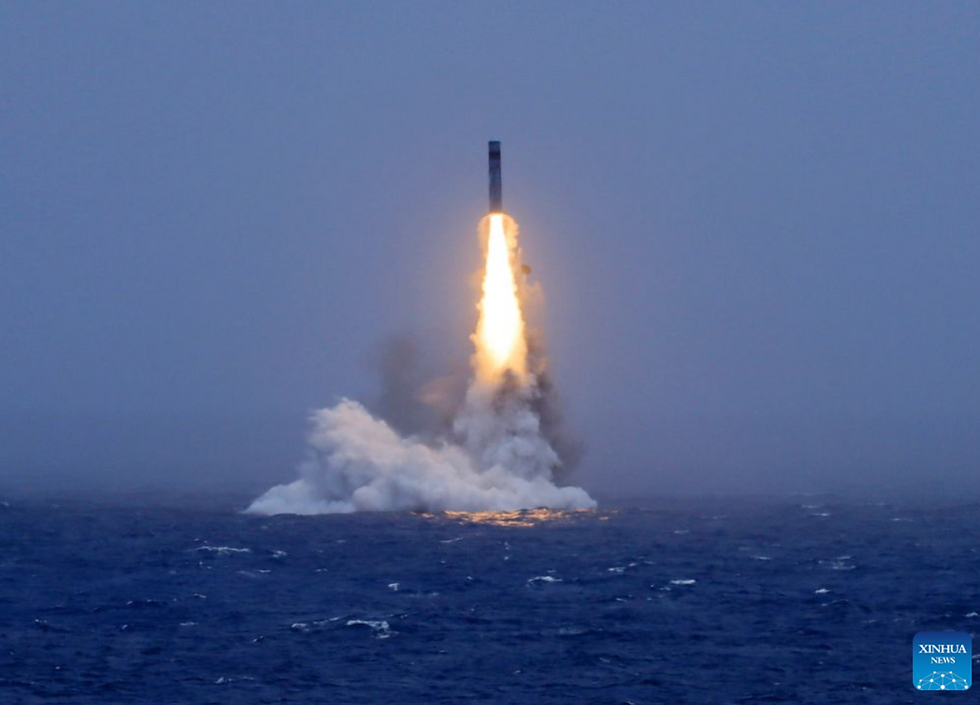
A genuine strength of the chapter is that it resists an arms-race narrative built purely on warhead counts. China's stockpile (approximately 620) remains far smaller than India's growth trajectory might suggest is being raced against, and the report instead frames the competition in terms of survivability and second-strike credibility, a more accurate lens for what is actually driving procurement on both sides.
One prominent limitation, the report itself does not restate India's declared doctrine of credible minimum deterrence and No First Use anywhere in this chapter , it is simply assumed as background. Similarly, the chapter's treatment of the dyad is confined almost entirely to force posture and technology; broader political drivers such as the Line of Actual Control standoff receive no real discussion in the chapter, and are addressed elsewhere
3. India - Pakistan Nuclear Dyad and China's Impact
SIPRI argues that although India's modernization increasingly addresses China, Pakistan remains central to India's immediate nuclear planning. The report identifies the May 2025 India-Pakistan military confrontation as the most serious armed conflict between the two countries in decades. SIPRI views this as evidence that nuclear deterrence continues to prevent deliberate escalation, while simultaneously warning that future crises may become increasingly difficult to control. The chapter also explicitly warns that the confrontation marked a shift in regional dynamics and that the risk of rapid, unexpected escalation is now a 'lingering and serious concern' .
Pakistan's stockpile is reported as stable at roughly 170 warheads, with continued investment in fissile material production and delivery systems expected to expand the arsenal over the coming decade, though SIPRI is explicit that forecasts vary considerably given limited public data.Land and air legs are described as well established, while sea-based systems (the Babur-3 SLCM) remain in development and are not yet operational.
Technological competition also shapes the India-Pakistan dyad. SIPRI notes that both countries are developing dual-capable missile systems, while Pakistan continues work on the MIRV-capable Ababeel missile. Although Ababeel had not entered operational service by January 2026, its development reflects Pakistan's attempt to offset India's improving missile defence and strategic capabilities.
China significantly influences this bilateral nuclear relationship. India's growing emphasis on longer-range systems is primarily driven by China's expanding capabilities, yet these improvements inevitably alter Pakistan's threat perception. Consequently, Pakistan continues expanding its own arsenal and delivery systems to maintain strategic parity with India. SIPRI therefore illustrates that South Asia increasingly resembles a triangular nuclear competition, where China's modernization indirectly accelerates India's modernization, which in turn stimulates Pakistan's nuclear expansion.
The report's greatest strength lies in showing that the South Asian nuclear balance can no longer be understood as a simple India-Pakistan rivalry. Instead, it is increasingly shaped by China's strategic rise and the interaction of three interconnected deterrence relationships..
Overall, SIPRI presents a balanced and evidence-based assessment of South Asia's evolving nuclear dynamics. It concludes that while nuclear deterrence has thus far prevented full-scale war, ongoing modernization, technological innovation, and growing nuclear-conventional entanglement are increasing the risks of miscalculation and unintended escalation in one of the world's most volatile nuclear regions.
4. Conclusion
The chapter is empirically strong, cautious in its handling of uncertain intelligence claims (consistently flagging assessments as uncertain, unconfirmed, or based on private communications with officials), and effective at connecting force-posture data to broader stability arguments. Its principal limitations are a light treatment of arms-control alternatives following New START's lapse, minimal engagement with the political and territorial drivers of South Asian and Sino-Indian tension, and specific to the Pakistan section no discussion of external assistance to its nuclear program.
Note - Stuti Sharma is a research intern with Security Risks Asia



Comments