India Defence: India Russia Sustaining Military Technical Cooperation to 2075
While the US Congress has passed the Lindsey O. Graham Sanctioning Russia and Iran Act of 2026 a day ago calling for levying 100 % levies for importing oil and gas from Russia and the CAATSA is in vogue since 2017 specifically targeting arms imports from Russia, all available indicators are of India Russia military technical cooperation extending in the long term. Here is an overview-
A Ministry of Defence Press Release on September 16 stated that General Dhiraj Seth, Chief of the Army Staff (COAS), is on an official visit to Russia from 16 to 18 September 2026.
Russia is the first major strategic partner that General Seth is visiting after taking over command of the Indian Army in June this year. While he did visit Nepal in August this was for the ceremonial purpose of conferring the Honorary Rank of General of the Nepali Army by Shri Ram Chandra Paudel, the Hon’ble President of Nepal.
The visit to Russia comes amidst attempts to dissuade India for strategic engagement in the past four and a half years after launch of the war in Ukraine. Europe and the U.S. amongst others have cajoled and even coerced India to delink from ties with Russia including in the economic and defence spheres.
India however has expanded energy imports from Russia which has become the largest supplier of crude and ironically today is providing Moscow refined petroleum when it is facing scarcity due to Ukraine’s campaign of attacks on refineries deep inside the country.
India has attempted to shift the over dependence on Russia for military equipment due to a variety of reasons such as delay in provision of contracted S 400 air and missile defence systems to greater focus on Atma Nirbhar Bharat in Defence [Make in India in Defence] and alternative contracting from other partners as France [Rafale] Germany [submarines] and United States [HALE drones and aero engines] amongst others. This has certainly reduced the exclusive dependence on Russia of the 1990’s and early decade of the 21st Century.
However, current indications are of a rejuvenation of India Russia military technical cooperation over the coming decades, with General Seth visit being an indicator. General Seth apart from other interactions will meet Mr Vasily Sergeyevich Osmakov, Deputy Minister of Defence, dealing with defence industry and procurement and Army-to-Army engagement.
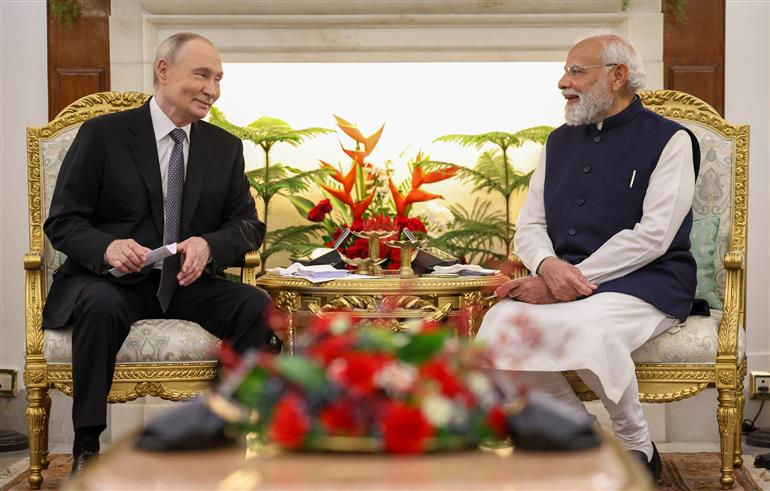
The high level political signalling in the past few weeks is also indicating expansion of engagement with India Prime Minister Narendra Modi and Russian President Vladimir Putin meeting twice in August–September 2026 – first on the sidelines of the SCO Summit in Kyrgyzstan and the BRICS Summit on September 12.
In the run up to President Putin’s visit to Delhi for the BRICS Summit, Kremlin spokesperson Dmitry Peskov flagged that the Su 57 fifth generation Russian fighters were on the agenda during the bilateral talks. "Su-57 jets are very sophisticated machines, and they are one of the best in the world. Selling these machines is on (Putin's Brics bilateral meet) agenda," he said who is a close confidant of the Russia President. He even went on to indicate willingness for sharing of the sensitive stealth fighter technology. Peskov said, "Indian scientists want production technologies, and this is a question for additional discussions which are underway. Every country wants to keep a sophisticated tech to itself. But we have advanced strategic ties with India and will thus discuss the possibilities of whether the technology can be made available to India. Such military cooperation is of great importance, but it can't be discussed openly and publicly."
Peskov also proposed possible cooperation in the next generation BrahMos system and said, "We are also jointly producing BrahMoS missiles. It is time to think about improving those missiles and adding some additional characteristics to make them more effective and competitive in the world."
While no public information has been released on the discussions over offer of platforms to India after the bilateral India has sought five squadrons of the S 400 air and missile defence system even as Moscow is reportedly keen on even offering the S 500 system which is under advanced development. India is also procuring the Tunguska air defence system apart from talks over the Super Sukhoi, an engine upgraded Su 30MKI and other military hardware.
In the long-term Russia India military technical cooperation can be expected to extend over many decades. In case the Su 57 is accepted by the Indian Air Force this could serve with the IAF well into 2075, beyond the Viksit Bharat mark of 2047. For comparison it should be noted that the IAF having inducted the Mig 21 in 1963 bid farewell to the flying machine despite being tagged as a, “coffin,” due to many frontline pilots losing their lives on 26 September 2025.
The Su 30MKI which was inducted in the early 2000’s has already seen 25 years of service and is likely to continue for at least two decades or more. Other platforms as SEPECAT Jaguar known as Shamsher inducted in 1979 is expected to serve the IAF into mid-2030s and so will the Mirage 200.
Even without the Su 57, ten squadrons of the S 400 air and missile systems could well continue for decades more. In fact, Russia holds a niche for quality air and missile defence weapons at affordable costs as compared to the U.S. front line systems as the Patriot.
On the defence industrial front, Russia is advancing partnerships with private and state-run manufacturers ranging from Adani Defence & Aerospace, Hindustan Aeronautics Ltd (HAL) and Bharat Dynamics Ltd (BDL) as reported by the Economic Times possibly in an attempt to shift towards technology transfer, local manufacturing and co-production in the Make in India mode.
The Lindsey Graham Act & CAATSA
All this comes against the backdrop of the US Congress passing the Lindsey O. Graham Sanctioning Russia and Iran Act of 2026 which amongst other stipulations is imposing “visa- and property-blocking sanctions on specified persons (individuals and entities) such as the Russian president, certain Russian military commanders, and any foreign person that knowingly provides goods or services relating to Russia's defense industrial base”
As one of the leading importers of Russia oil and natural gas India may also be subjected to an increase in the “rate of duty up to 100% ad valorem on all goods imported into the United States” from a country that was among the five largest importers of Russian-origin crude oil or natural gas if such country knowingly makes new purchases of such products after enactment of the bill.”
India had evaded sanctions under Countering America’s Adversaries Through Sanctions Act (Public Law 115‑44) or CAATSA enacted on 2 August 2017 for importing the first batch of S 400 from Russia and would hope to manage the same hereafter as well.
Conclusion
EAM Dr. S. Jaishankar’s valedictory address on the Silver Jubilee Celebration of Indian Council for World Affairs being designated as an Institution of National Importance highlighted the rationale and basis of India Russia Strategic Cooperation with a general statement saying, “Culture, history and experience remain factors of bonding between nations or otherwise”.
Many in the World may be flagging Moscow as a declining power, but India is likely to maintain a balanced partnership with Russia with a mutual sharing of strategic history from the 1971 Liberation War of Bangladesh to the post 1991 break up of the Soviet Union to the first quarter of the 21st Century which has survived many geopolitical transformations.


Comments