Hot Spots 2026: Taiwan Contingency Scenarios
- Security Risks Research
- Dec 23, 2025
- 7 min read
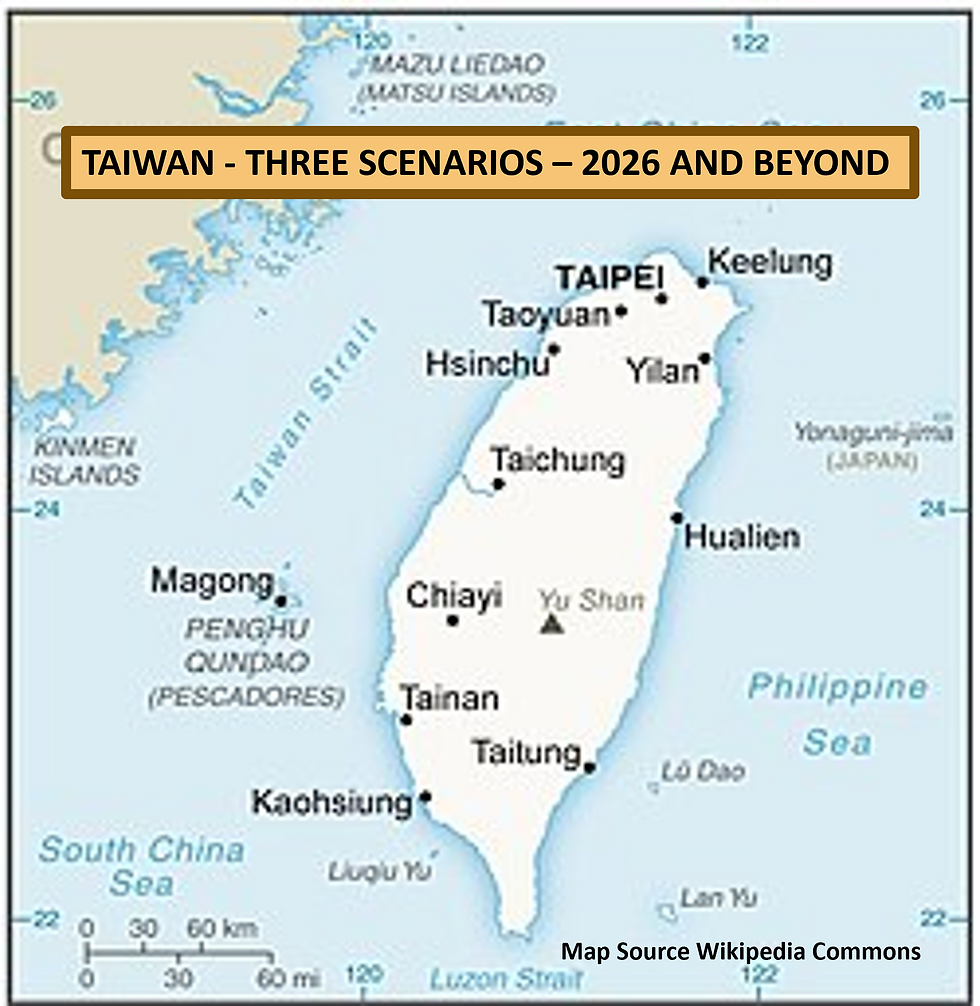
Can Taiwan be the Hot Spot in 2026, here is a simulation of military, political and geopolitical dynamics where great powers are looking for opportunities to achieve their sovereignty objectives?
Unification with Taiwan is one of the principal sovereignty objectives of the Chinese Communist Party and over the years a resolve to achieve this objective has only strengthened. Indeed a peaceful integration would be desirable but if not can an attempt for forceful occupation of Taiwan cannot be ruled out. Indeed from the military capability point of view, the People’s Liberation Army may not be fully ready to take on this contingency and assure a sure win for the President Xi Jinping which is essential from the Chinese perspective where, ‘face,’ cannot be lost to an adversary who has been belittled over the years.
More over tangible support to Taiwan cannot be ruled out, this was evident with the report on December 18 which indicated that the US government has approved a series of potential Foreign Military Sales (FMS) cases for Taiwan, technically, to the “Taipei Economic and Cultural Representative Office in the United States,” or TECRO, which is the de facto embassy in Washington.
The total sales amounted to an estimated $11 billion-worth of defence equipment, from rocket systems to aerial drones to howitzers.
This was the largest arms sale to Taiwan in US history and comes within weeks of a summit between the US and Chinese President in South Korea which had resulted in President Donald Trump remarking that a new G 2 was in the making.
That the US administration went ahead with the sales indicates the compartmentalised policies of the Trump administration with a mix of engagement and willingness for confrontation on issues that are considered in US national interests. Indeed the United States, Defence Security Cooperation Agency in each of the sales indicated that these “serves U.S. national, economic, and security interests by supporting the recipient’s continuing efforts to modernize its armed forces and to maintain a credible defensive capability.”
The sales would also “help improve the security of the recipient and assist in maintaining political stability, military balance, and economic progress in the region,” DSCA said.
· 82 High Mobility Artillery Rocket System (HIMARS), 420 ATACMS systems and other strike weapons, valued at up to $4.05 billion.
· 60 M109A7 Self-Propelled Howitzers valued at up to $4.030 billion.
· Altius Autonomous Air Vehicles valued at up to $1.1 billion.
· Tactical Mission Network Software valued at up to $1.01 billion.
· 1,050 Javelin Missiles valued at up to $375 million.
· 1,545 TOW 2B Missiles valued at up to $353 million.
· AH-1W Helicopter spare and repair parts valued at up to $96 million.
This is a vast array of fire power that will be used by the Taiwanese armed forces to neutralise any invasion.
Thus it was not surprising that Beijing was livid after the news broke out and came out with strong statements from the Ministry of Defence as well as Foreign Affairs saying, the arms package “grossly violates the one-China principle,” undermines stability in the region and “sends a gravely wrong signal to ‘Taiwan independence’ separatists forces.”
“China firmly opposes and strongly condemns it,” a spokesperson for China’s Ministry of Foreign Affairs said. “The Taiwan question is at the core of China’s core interests and is the first red line that must not be crossed in China-U.S. relations. No one shall underestimate the firm will and strong capability of the Chinese government and the Chinese people in safeguarding national sovereignty and territorial integrity.”
Taiwan’s defence ministry on the other hand said on X that Taiwan “appreciate[s] the US providing us with key defence systems,” including the Altius systems.
A Chinese defence spokesperson followed up saying China has lodged stern representations with the United States over the latter's massive arms sales plan to China's Taiwan region.
The move gravely violates the one-China principle and the three China-U.S. joint communiques and undermines China's sovereignty and security interests, Jiang Bin, a spokesperson for China's Ministry of National Defence said.
It also seriously undermines the strategic mutual trust between the two sides and sends a gravely wrong signal to the separatist forces seeking "Taiwan independence," the spokesperson noted, adding that the Chinese side is strongly dissatisfied with and firmly against the arms sales plan.
The spokesperson also warned the U.S. side that its connivance and support for "Taiwan independence" will only backfire, urging it to earnestly deliver on its promise of not supporting "Taiwan independence" and immediately cease its arms sales to the island.
Indeed, these statements indicate that China is unlikely to be deterred from the pursuit of unification.
Essentially this will have to be painless as even though the PLA is readying a formidable military including hundreds of ferries which can be converted into amphibious assault boats, the experience of the War in Ukraine would have shown to the Chinese that a strong national leadership in Taipei and support of the US amongst others may lead to a protracted war.
Unlike the Russians the Chinese people may not accept the pain of suffering the loss of even hundreds and not millions of youths losing their lives on the battlefield as Putin’s military has faced.
Thus. a swift and relatively painless military campaign would be necessary.
The Trump Administration in the United States with a decidedly different approach than others in the White House may be willing to accept China’s acquiescence of Taiwan just as it is willing to accept Russian demands of seizing the whole of Donbass and also has an inclination of its won as Greenland. In such a scenario, Beijing may see an opportunity for securing Taiwan.
Meanwhile on the political front a deadlock in Taiwan is evident. With the Executive Yuan and the Legislative Yuan now having a faceoff where the opposition which controls the latter even looking at impeaching President Lai Ching-te
The Legislative Yuan has passed an amendment to the Act Governing the Allocation of Government Revenues and Expenditures, but the Executive Yuan argued that the revised version would weaken the central government’s ability to adjust and coordinate subsidies for local governments, force the government to exceed the statutory debt ceiling, disrupting fiscal governance.
The Executive Yuan therefore submitted a motionv for reconsideration. The opposition now wants to impeach President Lai Ching-te, calling him a "dictator" for refusing to respect the will of the democratically elected legislature, though they lack the numbers, a two thirds majority to do so. They could instead pass a no-confidence vote in Premier Cho Jung-tai that might result in new elections.
On Dec. 15, Premier Cho Jung-tai announced—citing Article 37 of the Constitution of the Republic of China—that he would not countersign the amended Act, marking an unprecedented move.
On Dec. 18, lawmakers from the KMT and TPP formally petitioned the Control Yuan to impeach the premier and have demanded that President Lai Ching-te appear before the Legislative Yuan to explain his position and said they would hold public impeachment hearings across Taiwan.
The opposition does not have two-thirds majority to pass a resolution of impeachment.
To remove the Prime Minister, the opposition could pass a vote of no confidence in him. If that passes, the president has the right to dissolve parliament within 10 days with new legislative elections having to take place within 60 days. The standoff may wear itself out but only demonstrates the fragmented nature of Taiwan’s politics which could be manipulated by the Mainland to benefit.
Yet this may not result in collapse of Taiwan’s resistance to joining the mainland and retaining independence in 2026.
Taiwan will however remain a hotspot and the following three scenarios can be envisaged going into 2026 and beyond:-
Scenario 1 – Short, Swift Military Campaign. An attempted military operation before the large US arms package is effectively absorbed by the Taiwanese armed forces. This is unlikely for now given limited assurance of success and inadequate shaping of the regional and global environment to accept the Chinese version of a, “Special Military Operation,” replicating Moscow’s version of the war in Ukraine. China would also like the international cost of the reintegration to be low being seen as a regional hegemon as this will dent its image even as it pontificates high flown concepts as Global Civilisational Initiative amongst others.
Scenario 2 – Miliary Exhaustion - A more likely scenario could be sustained PLA coercive military actions in the Taiwan Straits to keep Taipei on an alert, provoke conscription with local resistance in youth and thereby trigger a popular political movement against the elected government.
This would imply intensified air sorties, naval patrols, economic and diplomatic coercion to wear down Taipei and testing U.S. resolve. PLA creates several military flashpoints in time and space spread over the year as each side attempts to wear out the other, with some having potential for larger escalation. These could be a series of manoeuvres to test the resilience of the Taiwanese government, people, and the government as a systematic campaign of exhaustion. Periodic blockades of the Taiwan Strait could be a corollary. The risk of miscalculation will remain high during such a scenario. This period will be utilised by the PLA to enhance capability for counter battery fire, suppression of air and missile defence assets to provide more military options.
Scenario 3 – Extended Deterrence. To offset the scenarios above Taiwan’s continued military capability enhancements to signal deterrence to the PLA and its masters of being entangled in a long, drawn-out war with thousands of casualties ruling out a military option. Sustained US support with advance release of the tranche approved in December 2025 of $11.1 billion and subsequent follow up assurance to strengthen missile and air defence, precision lethal fires against an amphibious invasion to make rapid seizure harder and costlier for the PLA. Over a period, a sudden escalation of this scenario to that of a swift military campaign will need to be watched out for.
Diplomacy – A Common Thread. In all these scenarios, expanded diplomatic standoff globally and regionally including regional actors such as Japan, the potential of which was evident with Chinese objections to statements by the new Japanese Prime Minister on Taiwan. This would have an economic and trade spinoff impacting economies in the region as even a minor tiff can result in affecting tourism. The risk of growing regional instability which could impact economies. In a way this is already underway.
G 2 Mediation - Given the state of US and China engagement on Taiwan, attempts at crisis prevention and avoiding escalation cannot be ruled out, yet the trust and confidence factor will remain low.


The Taiwan Strait remains one of the most scrutinized flashpoints heading into 2026. Professionals enrolled in executive courses in Taipei, Taiwan are witnessing these contingency discussions firsthand — geopolitics isn't abstract there, it's daily reality. Understanding escalation scenarios matters not just for policymakers, but for anyone operating in the region.