Three Years of Pain, What Lies Ahead for Manipur – Forecast & Road Map

Restoration of Manipur State Assembly was an attempt to facilitate political initiatives in the State after a year of President’s rule, this seems to have loosened the security grip to some degree. During the past two months, there was a draw down of security forces in Manipur for Elections in several states in the country such as West Bengal and Assam. The twin factors provided anti-state elements an opportunity to escalate their agenda of hate and violence which remains deeply entrenched in three years of instability.
Thus, many major incidents of violence occurred in April raising alarm. The escalation also marks a shift in violence from the Meitei-Kuki groups to Kuki-Zo and Naga groups, particularly in Ukhrul district. This horizontal escalation should be a cause of serious concern.
There is also a fall out of this in the political sphere as between Kuki civil society organisations, led by the Kuki Inpi Manipur (KIM), and Meitei organisations, including Arambai Tenggol (AT), which will need cross cutting measures across the security, political and administrative spectrum for control. Coordinating Committee on Manipur Integrity (COCOMI) an influential Meitei group also needs to be assuaged. With allegations and counter allegations by all concerned in the vortex of conflict the situation will continue to be grim.
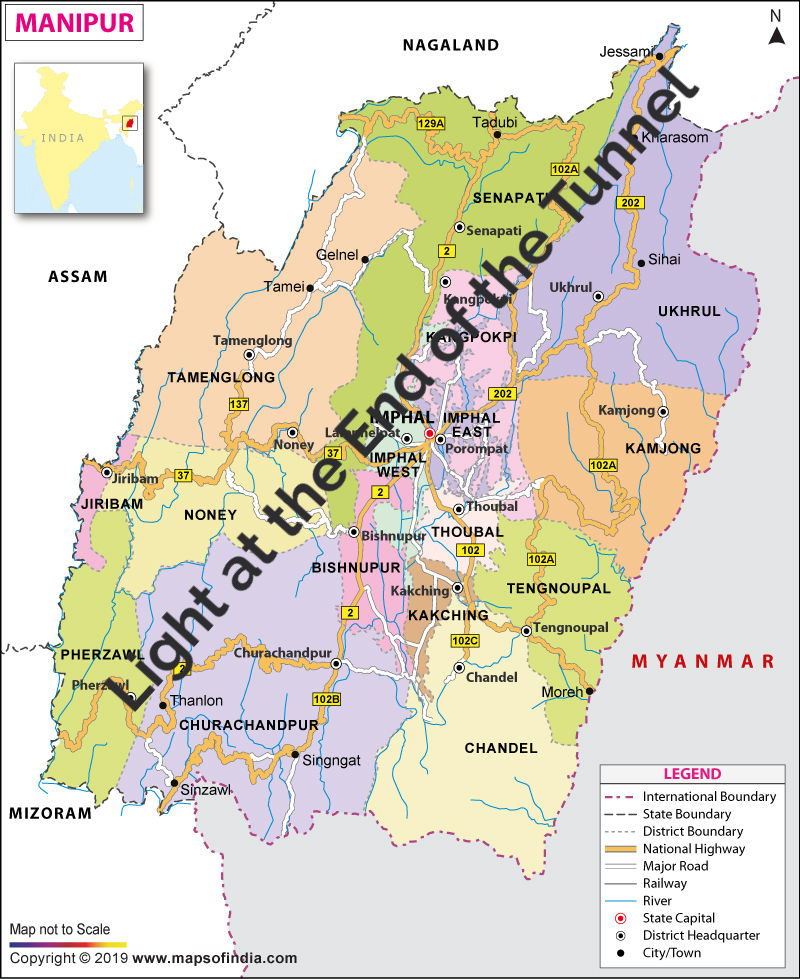
Ukhrul will continue to be a hotspot in Manipur after an upsurge in fresh violence and armed clashes between community groups. The district is the core of Tangkhul Naga identity, making it a focal point for Naga political mobilisation and a sensitive zone in the context of Naga peace talk dynamics.
While in the past three years as Meitei–Kuki tensions escalated elsewhere, Ukhrul’s Naga population asserted a neutral but guarded stance, creating friction with groups seeking territorial or political alignment.
Now an open conflict between the two communities Kuki and Meitei in the hill district will need sustained efforts for calm.
The National Socialist Council of Nagalim-Isak-Muivah (NSCN-IM) has dominant presence in the Ukhrul areas and is the voice of the Tangkhul community has condemned the killings, attributing responsibility to Kuki armed groups operating under the Suspension of Operations (SoO) arrangement and its role will be a factor in containing violence.
Ukhrul proximity to the porous Indo Myanmar border has also increased concerns about cross border movement of militants and arms, drawing heightened security attention.
There is also a gap in the security deployment. As Home Minister Govindas Konthoujam informed that out of 272 companies of the Central Armed Police Forces (CAPF) deployed across the state, 88 companies were withdrawn for election duties in West Bengal. 184 companies of CAPF were thus deployed in Manipur, clearly these were not adequate to contain the violence and its fallout.
Manipur chief minister Yumnam Khemchand Singh has been attempting reconciliation reaching out to the people, but his voice remains unheard even in the Meitei areas with some civil society organisations attempting to vitiate the atmosphere.
In a bid to remove the trust deficit between the Kuki and Tangkhul communities, Yumnam Khemchand Singh visited various villages of both the tribes in conflict in Ukhrul district as part of the trust-building mission. Singh said that every community has both good and bad elements, but every common citizen and every innocent child longs for peace and a peaceful life. He is also reaching out to multiple civil society groups across the spectrum.
The path ahead lies in restoring security particularly in the areas where ethnic and geographic faultline intersect, assuage the victims of violence, contain inimical militant groups on both sides and continuously engage with civil society organisations to gain their support in restoring normalcy. The larger challenge is thus restoration of inter-ethnic harmony.
In the long-term perspective deep-rooted ethnic tensions between the Meitei community in the Imphal Valley and the Kuki‑Zo tribes in the surrounding hills have arisen which has weakened the State identity at the cost of that of ethnicity.
The immediate trigger was the dispute over Scheduled Tribe status for Meiteis, which tribal groups feared would erode their land protections and political safeguards.
Long‑standing grievances—ranging from perceptions of Meitei majoritarianism, allegations of illegal migration, and competing claims over land, forests, and political representation—have kept tensions volatile.
Then state government’s rhetoric on issues like poppy cultivation and “illegal immigrants” further inflamed mistrust. Today the State government has adopted a conciliatory role.
Periodic flashpoints, such as bomb attacks, killings, and retaliatory protests, repeatedly escalate into wider unrest, prompting curfews, internet shutdowns, and clashes with security forces. The violence persists because structural ethnic divides, contested political demands, and cycles of provocation remain unresolved, creating a fragile and combustible environment despite resumption of the State Assembly.
The way ahead in Manipur is to tighten the security grid with a view to prevention of major incidents towards which targeting inimical armed elements outside the Suspension of Operation [SoO] process is essential. Simultaneously strict control over the groups which are under the SoO is also essential. Civil society in Manipur has a strong influence, engaging with diverse elements to bring these on board needs to be given a degree of priority. Cross ethnic channels of communication need to be encouraged. There is a need for patience and perseverance to rebuild communal harmony and willingness of the communities to share their rights. Examination of the constitutional framework desired by the ethnic communities needs a free and frank discussion. The path ahead is thus an uphill maze and the State will have to demonstrate the political will to reach the destination of peace and stability.


Comments