Impact Of Three Books Read By Me In May 2026

Col NN Bhatia (Retd) reviews three books read by him on contemporary subjects of military and general interest, have a look-
In the month of May 2026, I read 3 books as under:-
1. INSOMNIA: ARMY STORIES by Rachna Bisht Rawat,
2. The CURIOUS and the CLASSIFIED: Unearthing Military Myths and Mysteries by General Manoj Naravane, the former Chief of the Army Staff (COAS)
3. The Shadows Of My Life by Suresh Pandey.
The book reviews written by me are appended below.
INSOMNIA: ARMY STORIES

Ms Rachna Bisht Rawat is a renowned military author of many books but her bestselling books are ‘The Brave’ and ‘Kargil.’ Being a military veteran, in full military endearment, respect, fondness and pride with no negative connotation, I compliment Rachna Bisht Rawat, like my own children as ‘military brat’ who was born and brought up in the military cantonments around the country – her father, late Brig BS Bisht, was a paratrooper. She has a decorated paratrooper brother Col Sameer Bisht, SM, VSM and married to Sapper Army officer Col Manoj Rawat. Often children who grew up in military communities moving frequently from military cantonments or field areas, wear ‘brat’ as a ‘badge of honour’. The ‘brat’ (acronym for Born, Raised and Transfer or Trained) label signifies for Rachna Bisht Rawat, the world has always been olive green and wars and insurgencies unfolded in her close family with her father, brother and husband and many relatives and friends donning the military uniform, both in war and peace, in operational/ field areas and numerous cantonments. Rachna writes explicitly and absorbingly the military language, customs, etiquettes and culture not as a military daughter, sister or wife but as one fully conversant and involved say perhaps like her father, brother or husband understood by military touching their hearts, minds and souls. She has masterly ability to use, where needed, the aggressive, highly colloquial language sometimes laced with profanity, abuses and slangs often simply referred as military slangs, Fauji lingo or barracks and field area talks that build camaraderie and spirit de corps.
Almost all the stories, though fiction, are based on some real occurring in some peace/field /operational areas with the names of the regiments, units, individuals, timings and places changed. While reading these 17 stories any military reader like me felt fully involved and immersed in most of the events environment depicted or happening, notwithstanding the fact that some of them are bit exaggerated and could be avoided. Also, while officers, Junior Commissioned Officers (JCOs) or Jawans with in their groups may use such language, officers are not expected to use abusive or filthy language in front of JCOs, Jawans and their families as military leadership demands friendliness and respect and NOT cheap familiarity. The specific use of some western abuses or desi ones like ‘chutiya’ are classified as profanity, cussing, or vulgar pejoratives and avoided as these are broadly, the everyday conversational slangs used among military personnel where it fits the characters and military setting for sheer authenticity rather than serious writings on matters military, though the official writings always remains formal.
This book of 192 pages costing Rs 299.00 was first published by Penguin Random House India 2020 makes military reader feel part of its most settings and strongly recommended to be read by all military officers and their families but especially the young army officers and those teenagers motivated and desiring to join the Indian Army.
The CURIOUS and the CLASSIFIED: Unearthing Military Myths and Mysteries
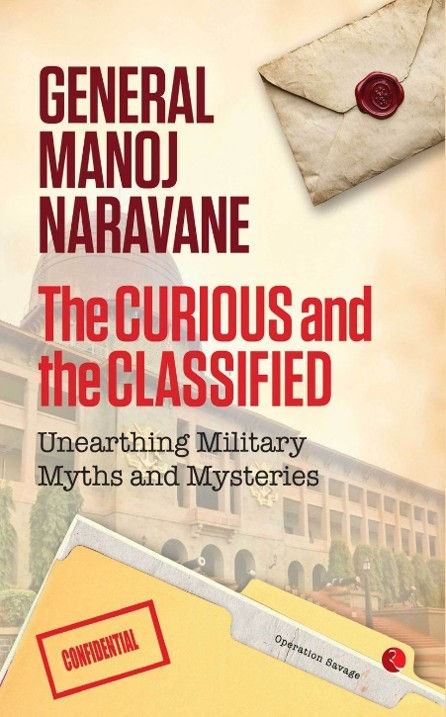
Son of Indian Air Force (IAF) officer, ‘military brat’ General Manoj Mukund Naravane, born in Pune (Maharashtra) was commissioned in the 7th Battalion, The Sikh Light Infantry (7 SIKHLI) in June 1980 and commanded 2nd Battalion, The Rashtriya Rifles (2 RR) as well as his parent 7 SikhLI Battalion. Although not ethnically Sikh, he fully embraced the regiment's language, religion, traditions, customs, and ethos, earning the respect and affection of his soldiers reflecting his deep sense of appreciation for regimental culture, soldierly traditions, and the unique bonds that unite officers and men regardless of their regional, linguistic, or religious backgrounds.
He served as the 28th Chief of the Army Staff (COAS) retiring from the active service on 30 April 2022 in his distinguished military career. General Naravane is regarded as a professional soldier and strategic thinker completely involved in military modernization, operational readiness, troops’ welfare, self-reliance in defence production, and stronger military diplomacy with partner nations.
After retirement, he is actively involved in changing regional and international geo-strategic scenario and matters military to enhance national security and combat effectiveness of our armed forces. He is a prolific and renowned military writer known for his books that include the military thriller ‘The Cantonment Conspiracy’ already read and reviewed by me and the non-fiction work ‘The Curious and the Classified: Unearthing Military Myths and Mysteries’, notwithstanding the fact that his memoir, ‘Four Star of Destiny’ is held up for the mandatory security clearance from the Ministry of Defence and awaited world over by the enthusiastic readers and admirers.
‘The book Curious and the Classified: Unearthing Military Myths and Mysteries’ is apolitical non-controversial and enjoyable collection of military folklore, traditions, legends, humour, regimental stories, and lesser-known facts about the Indian Armed Forces, colourful culture of numerous regiments, cantonments, war cries, military mascots, folklore, and military traditions rather than a hard-hitting serious military analysis on geo-strategic and national security issues. It is a common saying in the Army is that while weapons and equipment change over a period, the regimental history, customs, etiquettes, traditions and spirit endure.
The book has 25 chapters, each carrying an independent story or an anecdote on military myths, slangs and acronyms, valour cries, regimental traditions and officers’ mess life compartmentalized in 6 sections.
So, whether it is military rank or appointment absurdities, saluting differences in the army, navy or air force, meaning of dot on time, abbreviations and jargons, cheers like ‘Chak De Phatte’ or the legendary Assam Regiment song on ‘Badluram’, Mess life etiquettes and culture, somewhat false myths created about Baba Harbhajan (Hero of Nathu La) Rifleman Jaswant Singh (Hero of Nuranang), civil military relations or the final 3 letter French abbreviation PPC (pour prendre conge) written by all officers bidding farewell to arms without knowing its meaning, the book is full of wit, humour valuing military traditions.
In this interesting book, I learnt many things including the last one PPC that I wrote in the Officers’ Mess on my retirement without knowing its exact meaning. But I have some innocuous observations on a few things. While saluting with the rifle, striking the empty magazine with left hand makes louder noise signifying its emptiness as a friendly gesture. While the author has explained very well abbreviations and jargons like SNAFU or FUBAR, he somehow never abbreviated World War I, World War II and the United Kingdom as WWI, WWII and UK. At page 49, para 2 line 2, the author has quoted price of first prototype Bangalore Torpedo as 9 rupees, 5 annas and 10 paise-a rupee the being of 16 annas and an anna being of 4 paise, the cost should read 9 rupees, 7 annas and 2 paise. Also, while explaining ranks while Lieutenant is junior to Major BUT Lieutenant General is senior to Major General. I remember in 1964, an Anglo Indian officer Major LC D’Cruz, our second –in Command had told us that in the by gone British era, the actual rank was the Sergeant Major General and over a period Sergeant was dropped from the rank and therefore, Major General rank remains below the Lieutenant General. Likewise Major D’Cruz told us that officers in the Royal Navy and several other Commonwealth navies traditionally remain seated when toasting the monarch or the president of the country. This also is not highlighted. At page 113, para 4, line 7 Malaysia should read Malaya as it was known during those days. And yes, it is very common unwritten custom that our simple respectful rustic army jawans addressing all ladies including the lady officers as madam sir! And last but not the least, in otherwise grammatically correct vivid and lucid narration inadvertently the author has at page 193, para 2 line 6 made gender-neutral Adjutant with pronoun ‘she’.
The book would be too lengthy if all the above observations and some more stated below were added but interestingly many would like to know why some infantry regiments like the author’s own called The SIKH LIGHT INFANTRY, The MARATHA LIGHT INFANTRY and many others Rifles like The GARHWAL RIFLES, The GORKHA RIFLES, The ASAM RIFLES and so on. Briefly, the ‘Light Infantry’ traces its lineage to troops that were trained to move quickly, operate in dispersed formations, scout ahead, and fight more flexibly than traditional line infantry. Historically, ‘Light Infantry’ soldiers marched faster, carried lighter equipment, skirmished much ahead of the main force and often operated in broken terrain. While the ‘Rifles’ Regiments such as the various Gorkha Rifles, The Garhwal Rifles, The Assam Rifles and The Jammu and Kashmir Rifles, too march faster at the pace of 140 steps a minute vis-à-vis the rest all at 120 steps a minute, carrying lighter equipment and fit to fight guerrillas and insurgents in jungle and mountain warfare. They have distinct historical origins, customs and regimental traditions like wearing black pips/ shoulder tittles as a matter of camouflage. In a curious case JAKRIF vs JAKLI, many people confuse these two. While the JAKRIF traces its origins to the forces of the former princely state of J&K, the JAKLI originated from the J&K State Militia and earned its distinguished status through outstanding performance, especially in the 1947–48 and later operations.
They are separate regiments with different histories and traditions. In practical combat terms today, the distinction between ‘Light Infantry’ and ‘Rifles’ is mostly historical and ceremonial; the names are proud reminders of how those regiments earned their reputations over the centuries. In the modern Indian Army, all infantry soldiers of the numerous regiments carry broadly similar weapons and performs similar infantry roles. The terms ‘Light Infantry and Rifles’ are now primarily a matter of regimental heritage, traditions, battle honours, war cries, and identity rather than a separate operational identity.
This 220 pages book published by the Rupa Publications India Pvt Ltd 2026 costing Rs 595.00 should be read by all military officers especially the younger generations to learn about our rich military traditions, culture and outstanding leadership and bravery adding to our combat effectiveness.
The Shadows Of My Life by Suresh Pandey

The cover of the book ‘The Shadows of My Life’ encapsulates the central theme of the memoir both symbolically and evocatively. The juxtaposition of the Red Fort, a scooter-rickshaw, a cow, and bustling Indian street life with a Scandinavian riverside landscape, modern buildings, snow, and serene surroundings visually mirrors the author's life journey from India to Sweden. This imagery represents the warmth, colour, tradition, and cultural rootedness of his early years in India, while the Scandinavian scene evokes the orderliness, prosperity, and distinct natural beauty of his adopted homeland bringing them together in a harmonious composition, suggesting a synthesis of two cultures experienced by a migrant who has not abandoned his Indian identity in favour of Swedish but has learned to inhabit both with courage and pride. The thoughtfully designed cover serves as a visual metaphor for the author's successful blending of Indian roots with Scandinavian experiences, a theme that runs throughout the memoir.
Memoirs often succeed not because of extraordinary events but because of the authenticity with which ordinary lives are narrated. Suresh Pandey's book ‘ The Shadows of My Life belongs’ to this tradition chronicling the author's journey from the hills of Uttarakhand to Delhi and eventually to Sweden, tracing a life shaped by migration, perseverance, adaptation, and enduring attachment to one's roots. Pandey's narrative unfolds through a series of personal recollections that illuminate different phases of his life. He writes about his childhood in the Himalayan region, his education and professional experiences in India, and the challenges of adjusting to a new society abroad. Throughout the memoir, there runs a persistent thread of nostalgia for the landscapes, values, and relationships that formed his early identity.
The book's greatest strength lies in its sincerity. Pandey does not present himself as a heroic figure conquering impossible odds. Instead, he offers a candid account of successes, disappointments, cultural encounters, and personal reflections. This honesty gives the memoir an immediacy that many readers, particularly those familiar with the immigrant experience, will appreciate. His observations on the contrasts between Indian and Swedish society are often thoughtful and revealing, highlighting both the opportunities and emotional costs that accompany migration.
The memoir also serves as a social document. Beyond the story of one individual, it reflects the aspirations of a generation that sought education, employment, and a better future beyond the confines of birthplace and circumstances. Readers interested in the experiences of the Indian diaspora will find much that resonates in these pages. The author also highlights with pain that while his generation has links both with India and Sweden, the new generation born and brought up in Sweden, though having well-adjusted in their new Scandinavian environment, have not inherited their Indian cultures and values.
Yet the book is not without shortcomings. Its most significant weakness is the lack of careful editing. Grammatical errors, inconsistent capitalization, spelling mistakes, and occasional stylistic lapses occur with sufficient frequency to distract the reader. Proper nouns are not always treated consistently, and some passages would have benefited from better revision. Also, while in perfect English name is written Suresh Pandey or Mr Suresh Pandey in author’s Hinglish it is written as Suresh Pandey ji. These editorial deficiencies diminish the literary polish of a work that otherwise possesses genuine emotional substance. Nevertheless, it would be unfair to judge ‘The Shadows of My Life’ solely by its technical imperfections. At its heart, the memoir is an honest and humane account of a life lived across cultures and continents. Pandey writes with affection for his homeland and gratitude for the opportunities he found abroad, while never losing sight of the sacrifices that migration often demands.
Published by the Pustak Mahal, primarily the India's largest publisher of mass appeal books in low-cost paperback editions, the book comprising 152 pages costs Rs 195.00 that should be read by all those who are planning to settle abroad—particularly in Sweden and other Scandinavian countries. It provides a firsthand account of the opportunities, struggles, and adjustments that accompany such a transition. It is this practical and experiential value that makes the book worth reading despite its editorial flaws.


Comments