China's Marine Corps: A Deep Dive Asia – Assessment and Analysis
- William Lalrinzuala
- Jun 24
- 5 min read
Overview
The Madison Grand Strategy Project, on June 3, 2026, hosted its first Wednesday sea power workshop on the People's Liberation Army Navy Marine Corps (PLANMC). It brought together Ret. US Navy Captain Carl Schuster, former Director of Operations at USPACOM's Joint Intelligence Centre and author of over 900 defence publications and David Craig, editor of Real Clear Defence and a retired Marine Corps intelligence analyst whose 2010 graduate thesis examined China as a regional hegemon in Southeast Asia. The session, hosted by Paul Gara, is among the more substantive open-source treatments of the People's Liberation Army Navy Marine Corps (PLANMC) available. This review provides an assessment of the workshop and examines the force's evolution, doctrine, and strategic implications for Southeast Asia, drawn from the workshop's analysis.
The Chinese Marine Corps, known across the world as the People’s Liberation Army Navy Marine Corps (PLANMC), has, in the past eight years, gone through one of the most consequential and least scrutinised military transformations and developments. The goal of expanding personnel to 100,000 souls by 2025 has enabled the force to evolve into a sophisticated, multi-domain expeditionary force, especially with its naval amphibious lift that has quadrupled since 2016.
A Force Built for Coercion, Not Just Combat
The session’s account of the PLANMC’s institutional history was a useful corrective. Its current capacity and capability are a product of decades of deliberate correction, not long-standing competence. The force was first raised in 1952 under Mao Zedong, disbanded five years later due to resource constraints and doubts about military loyalty. It was then reestablished in 1980 after the Sino-Vietnamese War exposed how underprepared and overwhelmed the PLA was for amphibious operations. During that conflict, troops landed seasick and disorganised, supplies were loaded in the wrong order, and the force sat combat-ineffective on the beach for hours — escaping catastrophe only because Vietnamese forces were occupied elsewhere. A secondary lesson proved equally lasting: Vietnamese reserve sappers wreaked havoc in Chinese rear areas, destroying ammunition depots and hitting headquarters, demonstrating the asymmetric power of special operations forces against a conventionally superior enemy.
This humiliation led Deng Xiaoping to re-establish the PLANMC on 5 May 1980 with a mandate to build genuine amphibious capability from the ground up. Throughout that decade, the force conducted a close and deliberate study of US Marine Corps doctrine. From inception through at least 2018, Taiwan remained the primary planning focus, with early brigades assigned to the Eastern Theatre Command alongside two PLA Army amphibious brigades as a dedicated second echelon.
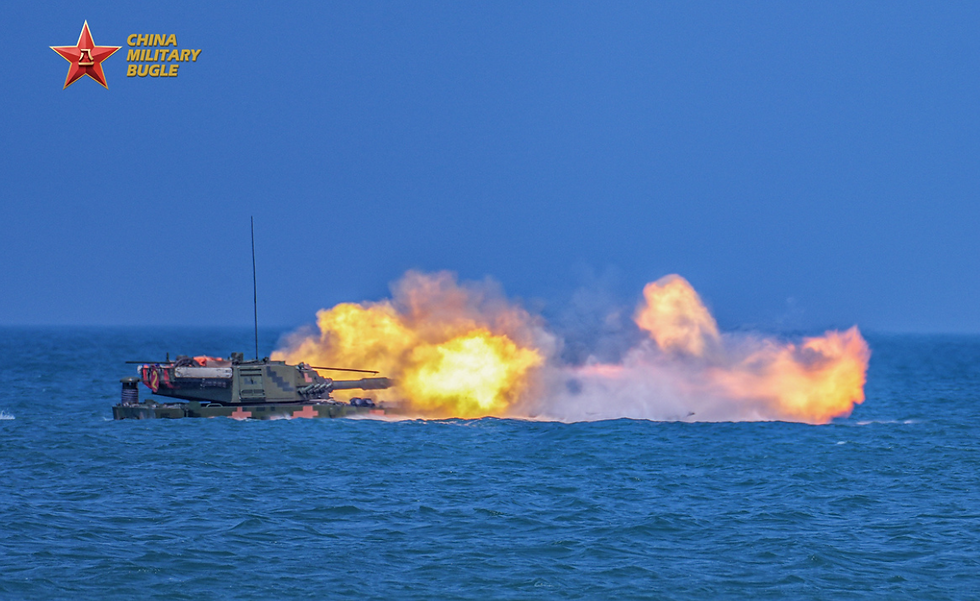
That correction has accelerated sharply since 2018; under Xi Jinping’s Expansion, Beijing ordered the force expanded to 100,000 personnel. Amphibious lift has quadrupled since 2016; Type 075 helicopter assault ships are now in service with the Type 076 in trials, an aviation brigade was added around 2020, and the special operations element has grown from roughly a battalion to a full brigade. Notably, the PLANMC is being equipped more heavily than its American counterpart, not less: light amphibious tanks with 105mm guns and infantry fighting vehicles, even as the US Marine Corps sheds armour for a lighter posture.
Doctrine and Lift
Doctrine matters as much as hardware here. The presenter described a sequenced approach to amphibious operations, cyber and electronic warfare to blind communications, missile and air strikes to suppress defences, and political-psychological operations designed to isolate and collectively degrade the targets' morale and mental fortitude. This is followed by a barrage of heavy air, drone and missile strikes, which suppress physical defences. Physical assault teams begin their operations with the Special Forces clearing and breaching obstacles and inshore mines covertly, with the landing itself treated as a near-final formality. A mobile port system, pontoon-based piers, which enables logistics buildup without seizing an actual harbour, reinforces the same logic. Hence, this is a clear-cut force designed to make resistance look futile before a shot is fired, not to win a prolonged fight. In addition, that doctrinal picture rests on inference from exercise patterns and open-source writing rather than confirmed planning documents, a caveat the presenter flagged himself, but the pattern is consistent enough to take seriously.
The Threat To Southeast Asia
This is where the buildup of forces and their structure translates into regional consequences. The foremost indication is in the South China Sea, where recent commercial satellite imagery has detected new construction at Scarborough Shoal being constructed covertly, without official announcements, in a pattern identical to the so-called fishing shelters China erected three decades ago before establishing larger permanent presences. A quiet shift from blockading the feature to physically building on it. If developed along the lines of earlier reef construction, a presence there would extend Chinese monitoring of air and sea space well north of the Philippines' Batanes Islands, tightening surveillance over a strait of real strategic value. The more immediate threat to the Philippines and other claimants does not currently run through the PLANMC at all. China's coast guard and maritime militia are doing the coercive work in the South China Sea today, with the Marine Corps held in a defensive garrison role. But the workshop's more significant claim was that the seizure of disputed islands and reefs is increasingly treated as a standing PLANMC mission rather than a hypothetical one - particularly as the US Marine Corps' own island-based littoral concepts mature and become targets in their own right. That shifts the Marine Corps from a background capability to a live contingency that planners in the region should be tracking.
Beyond the South China Sea, the threat takes a softer, non-military form, utilising its topographical edge. China, having control over the upper basin of the Mekong, has cut off water flow into Vietnam by close to 40 per cent, causing incalculable harm to rice, paddy and fishing output in the Mekong Delta. Thus, posing a leverage that substitutes for military pressure entirely. Beijing's decision to deepen ties with Laos, which is a long-standing Vietnamese ally, has effectively opened access to Vietnam's western flank. Cambodia, on the one hand, remains contested ground between competing patrons, a result of their decision not to align with either side. In addition, Indonesia has pushed back against Chinese activity in the Natuna Sea, while Malaysia has stayed largely quiet, a calculation that silence may keep Chinese pressure directed elsewhere. The session was candid that no shared regional security framework currently exists; even the ASEAN security sector lacks a unified framework which is specifically designed to collectively counter Chinese pressure and to unite Southeast Asian states, which is itself part of the threat. Hence, Beijing's approach and their indifference towards the China-ASEAN Code of Conduct in the South China Sea exploits the absence of collective response capacity as much as it exploits any single country's weakness.
Conclusion
Taken together, the workshop advocates a clear threat assessment. It is evident that China is not visibly racing toward a near-term amphibious assault in Southeast Asia, but it does not need to. It is building the tools for coercion without operating on hard power, instead resorting to political pressure, economic leverage over transboundary assets, incremental construction on contested lands while holding a rapidly modernising Marine Corps in reserve, capable of seizing contested features quickly should the calculation ever favour it. The practical danger for Southeast Asian states is less a single dramatic landing than the steady erosion of agency over water, fisheries, and unmonitored construction, compounded by the region's limited capacity to respond collectively. The PLANMC does not need to invade to reshape the region's strategic geography; it only needs to remain ready while everything short of war does the work.
William Lalrinzuala is a research intern with Security Risks Asia


Comments